
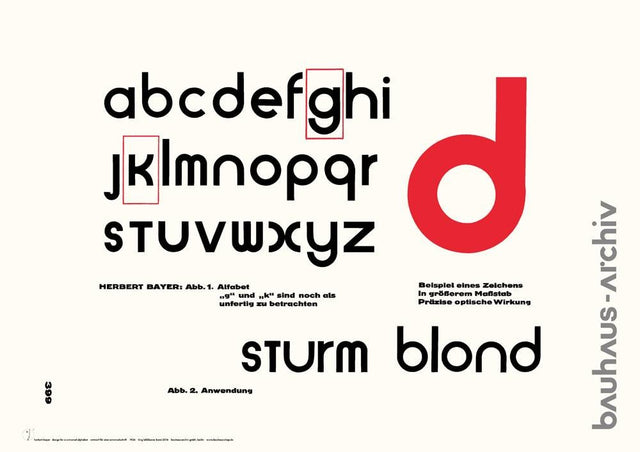

Poster No. 20 Universal Alphabet | Herbert Bayer
- Delivery time within the country 2-5 working days
- 30-day return policy
- With every purchase, you support the Bauhaus Archive Museum of Design
“Attempt at a New Typeface” is the title of Herbert Bayer’s 1926 text in the Bauhaus issue of the magazine Offset. The article is illustrated on page 399 with his design for a new “alphabet.”
“Just as modern machines, architecture and cinema are expressions of our modern age, so must typography be,” Bayer demands. Strict lowercase, simplicity, unity in construction, composition in the primary forms of the square and circle—these are his requirements. These principles shape many Bauhaus designs around 1926.
On the published sheet, two characters, g and k, are described as still unfinished. Bayer thereby makes the design process visible.
Herbert Bayer’s design is an idealization of simple construction and universal application. However, legibility was neglected; the typeface is better suited to logos and individual words than to longer texts.
Herbert Bayer used the universal typeface in the 1960s for the Bauhaus-Archiv Berlin logo he designed, which was also adopted by the Bauhaus-Shop. The ‘a’ and ‘r’ were simplified further, while the ‘h’, ‘u’ and ‘s’ characters were taken from the then-popular Helvetica typeface. To create a more harmonious form and improve the legibility of the lettering, the inner angles of the ‘a’ and ‘v’ have insets.
DIN A1 format (59.4 × 84.1 cm)